

Daily Tip Payouts vs. On-Demand Pay: Choosing the Right Cashless Tips Approach


A practical guide to the two ways cashless tips actually reach tipped workers—and how to tell them apart.
Key takeaways
- Cashless tips can be delivered to workers in two distinct ways: as true daily tip payouts (the worker receives their actual tips, paid out same-day) or as on-demand pay advances (the worker withdraws an estimate against tips they're projected to earn, with reconciliation later).
- True daily tip payouts are real payments, not advances. There's no repayment, no payroll reconciliation, and no risk of an over-advance.
- On-demand pay (a form of earned wage access, or EWA) is a strong fit for base wages between pay cycles, but applied to tips it introduces estimation, repayment, and reconciliation dynamics that don't exist when tips are simply paid out daily.
- The right model depends on the use case. Many employers benefit from offering both: daily tip payouts for tips and on-demand pay for wages.
Tips have always moved fast through hospitality. Cash on the bar, change at the host stand, an envelope at the styling chair, a folded bill at the curb. But as guests stop carrying cash and pay overwhelmingly with cards, tip dollars now spend their first life as data, sitting in a POS, a payroll system, or a tip pool spreadsheet, instead of as something a worker can walk out the door with.
That shift has changed what workers expect. Tipped employees who once left a shift with cash in hand are now waiting hours, days, or even a full pay cycle to see what they earned. And that wait has consequences: it's one of the top reasons hospitality workers cite when they leave for a competitor that pays out sooner.
Operators get it. The question isn't whether to accelerate cashless tip payouts but how. And while the industry tends to lump all "instant pay" options together, the way workers actually receive their tips can look very different depending on the model you choose.
Here's how to tell the two main approaches apart.
What are cashless tips?
Cashless tips are tips paid to workers digitally, into a deposit account, debit card, or pay card, rather than handed out as cash at the end of a shift. They typically originate as credit card tips through a point-of-sale (POS) system, get calculated (and often pooled or shared) according to the employer's rules, and are then distributed to workers electronically.
The shift to cashless tips has been driven by two trends: guests carrying less cash, and operators looking to eliminate the operational burden of nightly bank runs, on-site cash handling, and manual tip-out math.
What is on-demand pay for tips?
On-demand pay, also known as earned wage access (EWA), lets workers draw a portion of their earnings before payday. Applied to tips, some EWA providers have started letting workers request an advance on what the system estimates they've earned in tips so far, typically a percentage of projected tips based on shift data or historical averages, before the tips have actually been calculated, attributed, and paid out by the employer.
The tip dollars themselves still move on the employer's normal schedule, often as part of a paycheck or a scheduled tip distribution. The advance is then reconciled, usually by deducting the advanced amount from the worker's eventual paycheck or pulling it back from the worker's account.
Two other mechanics are common to this model and worth knowing about:
- Fees or a direct-deposit requirement. Most on-demand pay providers charge a fee for each advance, typically a small flat charge or a percentage of the amount withdrawn. Some waive that fee only if the worker switches their primary direct deposit to the provider's account, routing future paychecks through the provider rather than the worker's existing bank or credit union.
- Combined wage and tip access. When on-demand pay covers tips, the accessible balance usually bundles estimated tips together with accrued hourly wages into a single number. Both components are estimates until payroll runs, which means the worker's available balance can look larger than what's actually been earned. This can further increase the margin of error, as any over-advance gets settled later against the full paycheck rather than just the tip portion.
It's a real product with real benefits in other contexts. But applied to tips specifically, it introduces a few dynamics worth understanding.
What does it mean to "accelerate" cashless tip payouts?
Accelerating cashless tip payouts means shortening the time between when a tip is earned and when the worker can actually use it. Without acceleration, cashless tips often wait until the next payroll cycle, sometimes up to two weeks after the shift they came from.
Accelerated cashless tip payout solutions compress that timeline, typically to same-day or next-day delivery. To do it well, a solution needs to handle four things:
- Capturing tip data accurately. Whether tips are individually attributed or pooled and shared, the POS or tip-pooling system needs to produce a clean, reconciled total for each worker each day.
- Distributing the right amount to the right person. Pooling rules, job codes, hours worked, and tip-sharing agreements all have to be applied consistently, ideally without manual spreadsheet math.
- Funding and moving the money. The dollars themselves need to travel from the business to the worker on a daily cadence, including nights, weekends, and holidays.
- Giving workers real access to their earnings. Once funds arrive, workers need a way to spend, transfer, save, or withdraw them. It's best to have fee-free options so they can keep more of what they earn.
How a provider handles each of these steps determines whether daily tip payouts feel seamless or just shift the headache somewhere else.
Daily tip payouts vs. on-demand pay: what's the difference?
True daily tip payouts are real payments of a worker's actual tips, processed and delivered to the worker's account on a daily cadence. This is the model Branch follows. After the close of each shift or business day, the actual tip amounts each worker has earned are calculated, reconciled, and paid out, the same way wages move on payday or how restaurants pay out tips in cash tips each night, just compressed into a daily cadence and without the bank runs.
The defining detail: workers receive their tips rather than an estimate, an advance, or a portion to be reconciled against a future paycheck. The dollars that land in their account tonight are the dollars they earned tonight.
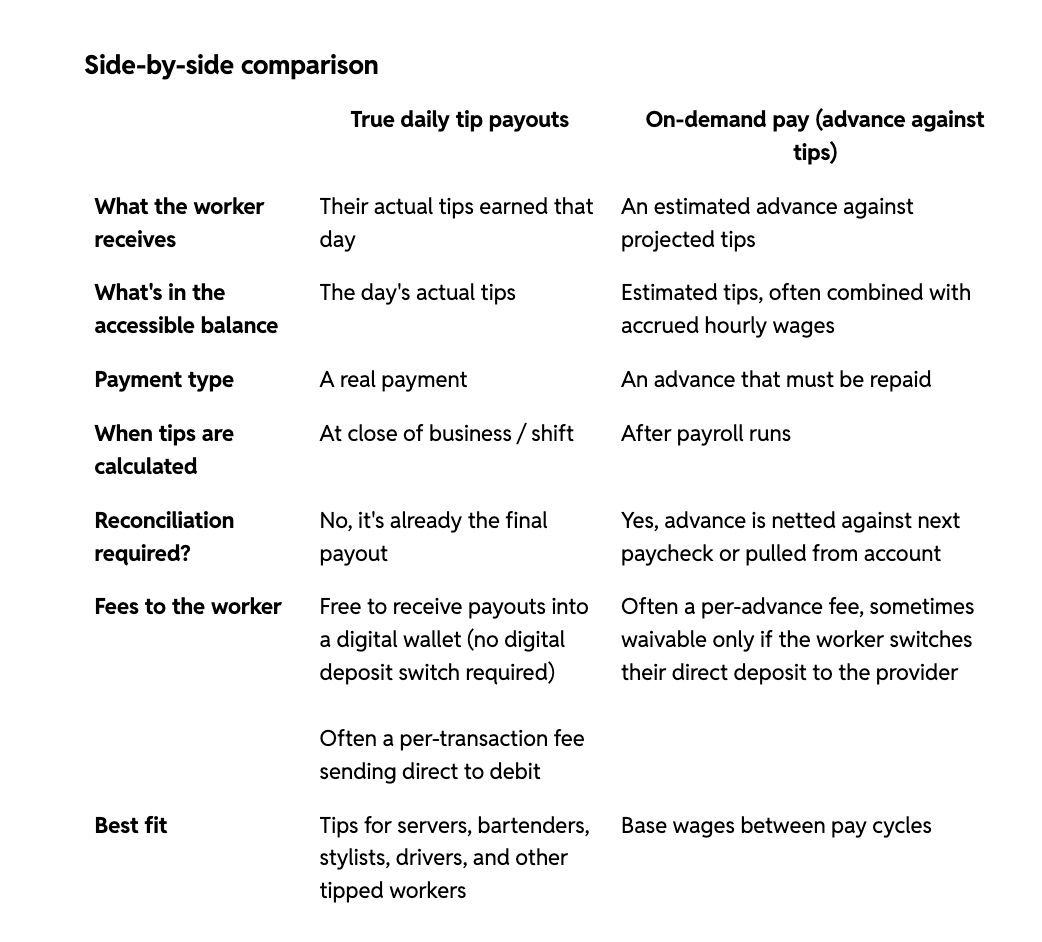
What to weigh when comparing the two
This isn't an either/or for every business, and it isn't about one model being categorically "better." It's about matching the model to the moment. A few things to think through:
Accuracy and trust. With true payouts each day, the amount that shows up in a worker's account is the amount they earned, which makes it easier to reconcile and explain. With advance-based models, the accessible amount is an estimate, and any over-advance has to be clawed back later. That can create awkward conversations and erode the trust that fast pay was supposed to build.
What's actually being advanced. When on-demand pay covers tips, the accessible balance often combines estimated tips with accrued hourly wages into a single number. That makes the available amount look larger, but it also widens the surface area for reconciliation. Projections that come in low, miscoded hours, or a shift that gets cut can all create over-advances that get settled later against the full paycheck, not just the tip portion.
Repayment dynamics. EWA models, by design, require repayment, typically through a deduction at the next pay cycle. For workers whose hours, shifts, or tips can swing week to week, having a chunk of an upcoming paycheck already spoken for can compound cash flow stress instead of relieving it.
Cost to the worker. True daily tip payouts arrive with fee-free options to receive them. Most on-demand pay providers charge a fee per advance, with the option to waive it only if the worker switches their primary direct deposit to the provider's account. That isn't necessarily a dealbreaker, but it's a meaningful ask for workers who've built their financial life around an existing bank or credit union.
Where the operational complexity sits. True payouts each day depend on a clean, automated tip calculation process, with seamless transition of real-time data or what solutions like TipCalc are built to handle. Advance-based models shift complexity into payroll reconciliation, since the advances have to be tracked against actual earnings after the fact.
Worker experience. When a worker checks their balance after a shift, do they see what they actually earned that night? Or what the system thinks they probably earned, with the full picture catching up later? The difference matters, both for financial planning and for how it feels to be paid.
Where on-demand pay still makes sense
None of the above means earned wage access isn't valuable, but that paying out tips require a different process.
For base wages between pay cycles, on-demand pay is genuinely powerful. It can give workers a way to handle an unexpected expense without turning to high-cost credit, smooth the gap between a bi-weekly paycheck and a larger-than-usual bill, and offer a meaningful financial wellness benefit that costs the employer very little to provide. Branch offers On-Demand Pay for exactly these reasons, and we've seen the difference it makes for hourly workers who would otherwise be stuck waiting on payday.
The distinction is that on-demand pay is most valuable when there's a real gap to bridge between earning and being paid. For wages held until the next payday, that gap is real. For tips that could be paid out the same day they're earned, the cleaner answer is to just pay them out.
How to choose a cashless tip payout solution
If you're evaluating how to move from end-of-cycle to daily tip payouts, here are a few questions worth asking any provider:
- Are you paying out the worker's actual tips, or an advance against estimated tips?
- How are tip totals calculated, and how do you handle pooling, sharing rules, and corrections?
- What happens on weekends and holidays, do payouts still land?
- Are there per-transaction fees for workers to receive their tips, and do you require them to switch their direct deposit to avoid fees?
- If on-demand pay is part of the offering, does it pull from tips alone or combine tips with hourly wages in a single accessible balance?
- How do workers access their funds once received? Are there fees to spend, transfer, or withdraw?
- What does reconciliation look like on the employer side, and what happens if a payout needs to be corrected after the fact?
- Can you support both tip payouts and on-demand pay for base wages, so workers get the right model for each kind of earning?
- Are you required to pre-fund? If your provider doesn't require pre-funding, that can free up your business' cash flow.
From servers and bartenders to stylists and drivers, the hospitality industry has long attracted and retained workers with real additional earning potential through tips and the chance to walk out at the end of every shift with those tips in hand. And as guests have moved away from cash, that expectation hasn't gone away. It's just gotten harder to honor.
True daily tip payouts are how operators continue to meet it. They preserve the same end-of-shift cadence that's defined tipped work for generations, just delivered digitally to the worker's account instead of as a stack of bills. The worker still walks out with what they earned that night. And the business gets back hours of nightly close-out time, eliminates bank runs, and removes the cost and risk of handling cash on site. An advance against estimated tips can take some pressure off a delayed payday, but it doesn't preserve the experience workers have always counted on, and it doesn't deliver the same operational lift. A true daily tip payout solution does both: it carries forward a hospitality tradition workers value, and gives operators a cleaner, lower-cost way to deliver it.
Learn more about delivering fast, cashless tips here.
Frequently asked questions
What's the difference between daily tip payouts and on-demand pay?
Daily tip payouts deliver a worker's actual tips on a daily cadence, as real payments that don't need to be repaid. On-demand pay (a form of earned wage access) lets workers draw an estimated advance against earnings before payday; that advance is later reconciled against the worker's paycheck. For tips specifically, actual payouts avoid the estimation and repayment dynamics that come with on-demand pay.
Is on-demand pay the same as earned wage access (EWA)?
Yes. On-demand pay is a common consumer-facing name for earned wage access, a category of financial benefits that lets workers access a portion of their earnings before the scheduled payday. Branch's product in this category is called On-Demand Pay.
Are daily tip payouts considered an advance or a loan?
No. True tip payouts each day are not an advance. They are real payments of tips a worker has already earned, distributed on a daily cadence rather than held until payday. There's no repayment, no interest, and no deduction from a future paycheck.
Do on-demand pay providers charge fees for tip advances?
Most do. The common model is a per-advance fee, either a flat amount or a small percentage of the withdrawal, typically with the option to waive the fee if the worker switches their primary direct deposit to the provider's account.
Does on-demand pay for tips include hourly wages too?
Often, yes. When on-demand pay providers extend their model to cover tips, the accessible balance usually combines estimated tips with accrued hourly wages into a single number. Both components are estimates until payroll runs, which widens the margin for error if actual tips or hours come in lower than projected.
Can workers receive cashless tips on weekends and holidays?
It depends on the provider. With Branch, cashless tip payouts can be delivered to workers' accounts on nights, weekends, and holidays, so tips earned on a Saturday night are available without waiting until Monday or payday.
How do daily tip payouts get reconciled with payroll?
With true daily tip payouts, there's nothing to reconcile from the worker's perspective; the tips have already been paid in full. On the employer side, the payouts are tracked and reported alongside payroll so that tip income is properly reflected on each worker's wage statements and tax filings.
What kinds of workers benefit most from daily tip payouts?
Tipped workers in roles where tips make up a meaningful share of total earnings: servers, bartenders, baristas, hairstylists, delivery drivers, valets, hotel staff, and similar positions. For these workers, getting tips after each shift (rather than waiting for the next paycheck) has a direct impact on day-to-day cash flow.
Can employers offer both daily tip payouts and on-demand pay?
Yes, and many do. The two models solve different problems. Daily tip payouts handle the tip portion of earnings; on-demand pay handles base wages between pay cycles. Offering both gives workers the cleanest version of each.
Does Branch offer both daily cashless tips and on-demand pay?
Yes. Branch supports cashless tip payouts (including fully automated tip pooling via TipCalc) as true daily payouts, and offers On-Demand Pay as a separate earned wage access benefit for W-2 employees.
Curious what fully automated tip pooling and daily cashless tip payouts can look like for your team? Learn more about TipCalc or request a demo.
Continue reading



Unlock a Happier, More Productive Workforce
